Monday, December 10, 2012

Rules for Parakeets

At the end, I'm going to quote Yann Martel in Life of Pi, which is an excellent book and an easy read if you haven't read it.

These are my parakeets.
L-R: Buttercup, Peepers, and Clair

They are all females, and they get along quite splendidly most of the time. Occasional squabbles over food or a favorite perch cannot dim their affection for each other.

Each has her own personality, and they are slowly learning not to fear me.

I love to watch birds; I always have.  I used to watch birds in parking lots and follow them around my backyard.  They have so much energy that they're endlessly entertaining, and for some reason, their antics are a continual delight for me.

The effect is only intensified with my birds.  I could sit for hours and watch them hop about, play with their toys, preen their feathers, and fly about my room. They're pretty much the perfect pet for me; they like and need lots of attention, and I'm the girl who used to narrate everything she did (and still does when alone). They don't care what I'm saying as long as I'm talking to them, and I don't care that they can't understand as long as they'll listen.

So I got to thinking one day what my laws would be for them if I somehow became the parakeet god. I wouldn't want to give them too many onerous laws to follow, but maybe one or two commandments would be reasonable.  So I thought that my first commandment to them would be:

"Be excellent to each other (or just stop picking at each other)."

Parakeets don't really have a pecking order, but they occasionally squabble and nip at each other with their beaks.  It's mildly heartbreaking to see creatures that I love so much fighting with each other.  I will give them more food if they run out or buy them more perches if there aren't enough, and grumbling at each other is really unnecessary. I wish that I could just talk to them for five minutes in parakeet-language and make them understand how precious and wonderful they each are, and that I will take care of them and provide what they need (and most of what they want) and that I love each of them specially, uniquely, and differently. It would be impossible to choose which I love more, because love doesn't work like that. Buttercup-love is not diminished by Peepers-love.  Peepers-love is not diminished by Clair-love.  Clair-love is not diminished by Buttercup-love.

But then I realized that would have to be my second commandment.  The first would have to be:

"Have no fear."

Parakeets are native to Australia, where they fly around in enormous flocks looking for water. They have many predators and no defenses. They do not have claws or camouflage or sharp teeth or tough scales or any sort of fighting ability at all. Their primary instinct when faced with even trivially novel experiences is to fly away, and their panic threshold is almost amusingly low.

As a result, any new toy must be subjected to at least 24-hours' scrutiny before being approached. A different kind of fruit will be untouched the first dozen times I offer it. Standing too close to the cage will prompt swift scurrying to the other side.  The ceiling fan is regarded as a large windy harbinger of death.

It's quite touching, given all that, that they've come to trust me as much as they do. Buttercup and Clair will generally let me hold them to feed them their beloved millet treats. Even the timid Peepers isn't usually afraid of my hand anymore when I'm changing their water or refilling their food.

But they're still afraid of so many things, because it's in their instincts. Their species grew up in a world full of danger, and their psyches reflect that.  I just wish I could somehow explain to them that they no longer need to be afraid, that I will always protect them and care for them, and that by bringing them into my apartment to live with me, I have eliminated their reason to fear. It served a purpose once, but I have removed the reason their psyche even knows timidity. I know they can't see that; they still believe they're in danger. But I so much wish they could, because I love them.

So in this odd hypothetical where I was the parakeet god, those would be my commandments:

1) Have no fear, because that world is gone, and
2) Be excellent to each other, because I love you more than you can ever grasp.

"... and so it is with God."

Monday, October 8, 2012

What I think about during Mass - the Our Father

So I'm going to write some things on here about what I think about during Mass (or I'm going to write one or two things and then forget about it).

Today I'm writing about the Our Father.  I think about a lot of things during the Our Father.  For one thing, it does not get old praying the same prayer over and over.  In fact, you see new layers in it, and sometimes it feels like the prayer gets stronger, deeper, and more heartfelt each time I say it.  It's like saying, "I love you."  It doesn't lose its meaning; if anything, it becomes more meaningful every time you say it.

I've always loved the simple beauty in the act of saying the Our Father together on Sundays, because that prayer is echoing around the world as parishes all over the globe say it together in dozens of different languages.  In this prayer, we are united. 

Perhaps because of the Our Father, I've fallen into the habit of praying in first-person plural.  I'm worried about my tests, so I pray that we may all succeed in our attempts to glorify our God.  I'm worried about my family's health, so I pray that we as a Church may receive healing for those we love.  I'm concerned about my friends, so I pray that we as a species can have inner peace and know how best to pass along that peace to each other.  It's an odd thing, but I've grown to love it, and it gets me out of my own head.

A couple of phrases in the Our Father often strike me: "give us this day our daily bread" and "lead us not into temptation, BUT deliver us from evil".

But what's struck me lately is where the Our Father falls in the Liturgy.  It's after the consecration, right after the Great Amen, when Christ is there in our midst on the altar.  It's a precious, beautiful thing to stand with the Church around the world and pray with Christ among us the prayer that Christ himself spoke, with the Son and to the Father:

Our Father
Who art in heaven,
Hallowed be thy name.
Thy kingdom come.
Thy will be done
On earth as it is in heaven.
Give us this day our daily bread,
and forgive us our trespasses as we forgive those who trespass against us.
And lead us not into temptation but deliver us from evil.


Like the Amen, I often think that the Our Father from our lips represents a submission from us, just like it represented the constant submission of the Son to the Father.  By praying that prayer, the one the Lamb on the altar prayed first, we join ourselves to his obedience and offer ourselves to God.

In response, the Father accepts our prayer as he accepted the Son's obedience.  Because of what Christ did, we "dare to say" the same prayer Jesus did and dare to call God our Father.  Greeting each other as brothers and sisters comes after that. The wedding supper of the Lamb comes after that.  And so the Our Father is not just "filler", and it's just as powerful whether it's sung or spoken.  For me, it's become one of the most beautiful moments of the Mass.

Thursday, July 12, 2012

Where, When You Have To Go There, They Have To Take You In.

Raining, raining, raining.  It's been raining on-and-off for about four days, and it's glorious.  I love the rain for reasons I really won't pretend to understand but that involve it being pretty and soothing and cathartic in some odd way.

But I didn't intend to write about rain.  I intended to write about home.

Home has always been a tricky subject for me.  My family moved from the town where I was born to the small town where I grew up when I was five years old.  I went to school there for three or four years before I became homeschooled.  But I don't remember ever, ever feeling at home there.  For whatever reason, my young psyche just rejected the place.  It's a nice enough town, but I never considered it more than a resting place between birth and college. 

When I was about fourteen, I started thinking about college full-time.  I don't mean that I started thinking about the idea of becoming a full-time student.  I mean that I started spending the vast majority of my waking hours thinking about college.  This isn't so surprising, as I was brought up to look forward to college the way a lot of girls look forward to their weddings.

But I did transfer every smidgen of my teenage angst and misfit issues onto the idea of college, latching on to the idea that I would be happy in college and finally feel at home.  This was when I rejected the little town I lived in as being home in any sense.  At the time, I even refused to think of it as my "hometown", despite the fact that I lived there for most of my life before I left for college.  I attached a number of grievances to the place, hoping subconsciously that if I convinced myself the problem was my little town, then my problems would be solved when I jettisoned forth from that little town into my own adult life.

When I finally, finally, FINALLY picked a college and moved there to study math, I finally found home in many ways.  I lived in an honors housing community that was superb in all the ways that don't show up on paper.  My little dorm room in that concrete building became the home I felt I hadn't had since I was five.

After I moved out of the dorms and into a little house off-campus with some friends, that house became home.  But I also had always had another sense that the place didn't matter when it came to home, and I remember thinking sentimentally that "home" was really where the man I loved was.  I really loved at least two men in college, and another probably goes on that list as well. By that definition, home was wherever he was.  Sometimes home was on highway 6 in my big red truck, if he was sitting in the other seat.  Sometimes it was the grocery store that was always so crowded, if he was there with me.  And sometimes it was Kyle Field, as long as he was there to be kissed when the Aggies scored.

But then, I also remembered when home shattered.  The room where we sat while we finally broke things off went from being the bubble of home in a frightening world to being just another place in a world that was homeless.

So where do you go in a world where you're homeless?  I was becoming Catholic by that point, and so I felt distanced from my family more than I had ever been.  My generation of Aggies graduated a few months later, and so my roommates and I all left that beautiful little house on the edge of town.  I wandered around Europe alone for part of the summer, which fits quite well into this narrative and acts as a poignant metaphor for my rootless existence at the time.


Home has always been a tricky subject for me, which is why I was caught so off-guard when I realized out-of-the-blue that I would never be "homeless" again, because there would always be the Mass.

Why had I never seen it before?  Mass was home.  It always would be.  It was the place where I would always be welcome, no matter what I'd done or how long I'd been gone. 
One key to understanding Mass is realizing that Mass is where heaven meets earth and earth meets heaven.  Like a metaphysical tesseract, the two altars (one here, one there) meet and merge, as do the priests who act in persona Christi. It's not a coincidence that the "Lamb of God" features so prominently in Mass, because it features prominently (and primarily) in the writings of John, who saw heaven and wrote about it in Revelation, nor is it a coincidence that the presence of the Lamb of God is so important in both the liturgy given in Revelation and the liturgy used on earth. We put relics of the saints under the altars because the martyrs in heaven cry out from under the altar.  There is silence and incense, white vestments (white is the color of the priesthood, though other colors are used for different seasons), the Sanctus, the sign of the Cross on people's foreheads, and a good deal more.  Revelation is poetical and deeply symbolic, but then so is Mass.

Like a good home, Mass doesn't always make me comfortable.  But it's always home, whether they're speaking English, Spanish, Latin, Vietnamese, Swahili, or whatever else, and whether it's in St. Peter's Basilica in the Vatican or in an old house that used to be a dentist's office just off the campus of Rice University.  And like a good home, it doesn't cease to exist or be my home when I'm not there.  Maybe that's why we call it "Mass" (from the Latin ite missa est, which means "it has been sent"): Mass is home, and home goes with you wherever you are. Deo gratias.


Thursday, February 16, 2012

What Works

Wow, I haven't written a blog post since last year.  Not acceptable.

But I'm afraid that while second semester has been less demanding academically, it's been more demanding personally to such a degree as to more than make up for it.  Most days, it's just too exhausting to contemplate writing anything here more substantial than,
"Grrrrr mean circulatory acid fast WHY IS IT RAINING AGAIN groan my birds are out of food and have no T cytotoxic cells and my serotonin hurts why?"
Then I'm supposed to keep doing things?  It's like the things never end.  (Hat-tip to Hyperbole and a Half.)

One way I try to cope with this is by finding great blogs online and devoting myself to them religiously.  I've gone through Zen Habits, Nerd Fitness, Conversion Diary, Psychology Today, and a number of others.  I think there was even a short Cracked stint in there, but I don't talk about that anymore.  (Just kidding.)

These are all great blogs, but in each case, I go there looking for life guidance.  I'm trying to find someone I can emulate and try to be just like in every detail.


The problem is, no one else has my life.

How do you take the advice of Zen Habits and simplify your life...


...when your life is subject to the whims of people trying to teach you every detail of the most complicated system in existence?


How does an unmarried, childless student emulate Jen Fulwiler or Simcha Fisher in their grace and devotion?

I'm a vegetarian, prone to injury, and a tad busier than most, so Nerd Fitness isn't always a great fit.

Psychology Today occasionally has some gems, but most of it isn't terribly applicable to a Catholic.  Also, my depression and attention problems were mostly under control last year.  Only now that everything has dialed up to 11 have my coping mechanisms stopped being able to keep up.

Older medical students are a great resource.  But even the female Catholic medical students usually don't understand what it's like to carry Churchill's black dog, to wake up and hope the weather will be nice today and that the inner hurricane will be far away today. (If you'd like a taste, not that I can imagine why you would, a group associated with MIT wrote Elude, which provides a pretty decent metaphor of depression and what it feels like.)


Even trying to be a carbon copy of Jesus Christ isn't quite it, for the simple reason that Jesus does not have my exact life.  Imitating Christ is always worthwhile.  But I don't just want a role model.  I want someone to have taken all the questions and uncertainty before me and made every decision ahead of me, effectively removing all doubt and risk.

Of course, the answer is to just do my best and make my own path. But making one's own path is risky, so I find myself longing for someone to mindlessly follow through all this. But I'm slowly learning to do what works and not beat myself up that I'm not just like someone else.  

Or I could just opt to try to be Kara Thrace, which is what I eventually settled on.


So I've spent most of this post complaining.  But I've discovered that the answer to almost anything is gratitude.  When I think about how lucky I am just to walk this earth and breathe this air, I can't feel anything but gratitude for every single moment of my stupid little life. 


Saturday, December 31, 2011

The Year in Review - 2011

Today is the last day of the year 2011.  In a sense, this doesn't matter much at all as a simply quirky day of an arbitrary calendar.  But for we mortals, the calendar gives rhythm to our lives and helps us understand this odd temporal bubble in which we find ourselves.


I'm musing on everything that's happened this year and how I'm different from the girl I was this time last year.

In January, I broke up with the man I really, truly, completely wanted to spend the rest of my life with.  If you haven't done that, I don't recommend it.  It gets really old to watch your friends get engaged and to hear platitudes from older married folks, and think, "When you found the person you wanted to spend every single day with for the rest of your life, you married him."
I was a complete mess.  I also went to Nebraska for a math conference, where I was a very cold complete mess.

In February, I got the lowest test grade I'd ever received in my life.  That was okay; everyone else did, too.  But this threw my medical school acceptance into jeopardy, and so for the next few months, all in the entire world that I wanted was to pass that class.

In March, my last Lent as a non-Catholic started.  I spent as much time as I could reading and studying, partly out of curiosity and partly out of obsession.  What can I say?  Converts are weird like that.

In April, I actually did become Catholic, and it was one of the best nights of my entire life.  At this point, life begins to get better imperceptibly slowly for me.  I credit the Eucharist.

In May, I passed that class by the grace of God.  My grandmother, who was a female mathematician and computer scientist in the 1960's, met my favorite math professor, who was the same thing except a professor instead. I rode home from graduation in an old Porsche driven by someone who knows how.  This was one of the high points of the year.

In June, I flew sixteen hours to Kenya and spent two weeks seeing things that still blow my mind, like elephantiasis, polio, and thyroglossal duct cysts.  I saw giraffes at dusk.  I snorkeled in the Indian Ocean and saw an octopus hiding in his den.  I drank chai and ate chapatis and rode in safari vans driving on the left side of the road.  I saw crocodiles being fed and watched a tiny premature baby learn how to nurse from his fifteen-year-old mother.  I gave injections and drained hydroceles and listened to the heartbeat of a baby in the womb. This was another of the high points of the year.

In July, I spent two weeks wandering around Europe alone.  This was a series of lots of high points of the year.  I saw London, the ancient and new city that is the beloved gem of all England.  I saw the great David Tennant in the theatre and got his autograph.  I saw the Tower of London and the Tower Bridge.  I adored London.
I saw the shores of France where the D-Day troops landed and walked through the castle of William the Conqueror.  I prayed a Rosary in Lourdes and brought back water from the spring that rose up there, as well as strolling through the beautiful town in the Pyrenees mountains where people spoke French and Spanish, but little English.  I rode trains through the south of France and stood in the Mediterranean Sea and watched the tide come in on the coast of Nice.  I took in the glories of the Italian countryside, each tiny village becoming the one I wanted to retire to someday, imagining watering the mounds of colorful flowers and herbs in the windowboxes and putting out bright white shirts to dry in the generous sun.
And then there was Rome.
I rode a train into the city of Rome, a city so used to being the center of the entire world that it's become part of the zeitgeist.  I saw the ruins of the ancient marketplace and photographed cats sleeping in the sun on the steps of the forum where Julius Caesar was killed.  I went to Mass in the oldest church in Rome (and therefore in one of the oldest churches in the history of Christianity).  I ate way too much pasta and drank red wine with every meal and learned how to make the most wonderful pasta recipe I've ever had.
I stood in line with an old Italian woman at 4:30 in the morning in St. Peter's Square in the Vatican.  We waited together, exchanging broken Italian and Spanish and English, then sat together during a beautiful Mass in St. Peter's Basilica celebrated by Pope Benedict XVI. I discovered that he looks like an adorable old man in person, and that the creepy photos you sometimes see are because he's not terribly photogenic, not because he actually is creepy.  I stood under the Colosseum and cried for the blood spilled there.  I went to Mass in Notre Dame in Paris and heard the beautiful liturgy in a beautiful language.  Back in England, I hiked up to Dover Castle and saw the French coast across the English Channel. I flew across the Atlantic Ocean, twice.

In August, I moved to Houston, Texas and started medical school.  It hit me like a battleship to the face.  I had never encountered any challenge so difficult in my entire life. In August, I met my best friend in medical school.

In September, first exams, first block week, first block party.

In October, Block 2 (of three) hit, and I was even less prepared than I was for block 1.  Block 2 was my worst block.

In November, I went home for Thanksgiving and realized how completely my day-to-day life had changed.  Thank you, medical school.  Also, Advent started, and we began using the new Roman Missal translation.

In December, I took block 3 exams and finals back-to-back: nine exams in two weeks.  Spoiler alert: I passed, by the grace of God.

Now here I am, wondering about the upcoming  year.  When I think back over my college career, I tend to recall individual semesters and wince at how difficult they were.  I don't remember a positive semester since freshman year.  But I remember individual good things happening.  And more than that, I remember the grace.  Even before I knew what I was asking for, the grace to handle the situation was always there when I asked for it.  Even when I didn't ask for it.

So here's to the really bad years that make you beg for the grace.  Here's to not being where you thought you would. Here's to the semesters that contribute to holiness, not to happiness.  Here's to the life that ebbs and flows and sometimes is not fair.  Here's to the God who gives all the grace.  Thank You, as always.

Saturday, November 12, 2011

Tiny Sharp Sins

If you have ever had a splinter, you will know exactly what I'm talking about.

Imagine having a bad, crooked splinter stuck in your skin, so that you couldn't move, couldn't do anything without feeling it.  Imagine if it were impinging on a nerve, so that it was either numb or intensely painful all the time.

Sometimes I don't even realize it's a splinter.

If you can, try to imagine that feeling growing and growing, so that it's not just in one finger but spreading throughout your body in waves of numbness and pain.  Then imagine that it's not a physical pain, but an emotional one, alternating through waves of numbness and pain and fear and feeling empty and dead inside.  Sometimes emotional pain is far more excruciating than any physical pain I've had.  You've probably been there.

But if you followed the first part of the metaphor, you probably also know the feeling of finally gripping the splinter with tweezers and extricating it.  It hurts, but then the skin relaxes back where the splinter was.  The whole limb seems to breathe a deep sigh of relief, feeling the blessed absence of the horrid sharp thing that caused so much pain.  Every few minutes you remember where the splinter was and feel such a depth of gratitude that it's finally, finally gone.

It's not always easy to tell a priest how long (or how not-so-long) it's been since my last confession, and then to tell him I did this, and this, and this, and this.  But nothing in all the world can replace that deep, quiet peace that remains once the dark, crooked splinter is finally pulled.  Much of the time, I'm surprised how much pain that tiny, nasty splinter caused; usually I had blamed the pain on everything in the world but the splinter.  But once it is finally out, I have to pause every few minutes and marvel that it's really, truly gone.  

Once again, how did I ever live before Confession?

Saturday, November 5, 2011

The Light and the Blind

Hello.  I am the automated robot that writes blog posts for Sarah in the event of her death at the hands of nasty medical school exams.

Just kidding, it's me.  

I said I had things to say after exams, so here I am; let the saying commence.

I left off in Sirens of Insanity by explaining how, for me, the use of reason leads to the death of reason at its own hands.  But I realized a few days after I posted it that I only explained why I don't think we can reason our way to ultimate truth; I did not actually explain what I do think.  The whole post left my inner editor-skeptic thinking, "Well, that's nice that you don't trust reason, but reason is humanity's only way to think about the world and come to conclusions.  So we had better trust it anyway, or else just accept our ignorance and stop trying."

(On the one hand, this is true.  Even though we know reason is ultimately flawed, we still use it to deal with the vast majority of the situations of life.  We know Newtonian mechanics is flawed. But we still use it for the vast majority of problems, because it works most of the time and only breaks down around the edges.  It's the same thing.  I think it is a mistake to turn against reason, and much of the Western world over the last three hundred years agrees.)  

So where do we go from here?  We cannot expect to derive all truths from observation and reason.  As I explained, there must be aspects of the ultimate truth that are immutably inscrutable to us and will therefore always seem illogical despite being completely true. 

Here is my metaphor.

Imagine that humanity was born into a giant biosphere that was utterly dark.  Because of the dark, we used our senses of hearing and touch to interact with the world and invented lots of tools to help us understand the world and not stub our toes on things in the dark.
(Of course, in such a situation, we would probably eventually invent flashlights, or even just fire.  But this is one place where the metaphor breaks down; no metaphor is perfect. I don't think it affects the conclusion.)

Now imagine that one day in one isolated little corner of the biosphere, light was found streaming in from the outside through a pinprick.  People couldn't touch it or hear it, but they have a seeing organ, the eye.  A part of them is sensitive to the light.

Some people would see it, but shrug it off as a weird... something.  Some people would see it and be forever moved by it in some way.  But some people would hold firmly to their senses of hearing and touch and remember all those principles had done for humanity. Then when the light remained silent and non-material, they would reject it.  Maybe it was a hallucination; many disease processes can cause flashes of light to appear.  Maybe it was a conspiracy.  Maybe it was wishful thinking.  Maybe it was an unsolvable mystery. In any case, they would see no reason to trust their sense of sight, especially when it seemed completely uncorroborated by hearing, touch, or common sense.

In fact, some people might have been born blind, and others might never have figured out how to open their eyes.  Some people's eyes might have atrophied.  Some of those people might believe it anyway.

Studies might be devised to see if consistent exposure to the light could cause any heat changes in a material.  Results would be mixed and probably not very impressive, and the methodology would be questioned extensively. Scientists would show that exposure to the light causes certain brain changes that are also observed under such-and-such other conditions.  They would show that people seem genetically programmed to see the light.
People would use the light and the perceived lack of light as excuses to indulge various hideous parts of themselves and as inspiration to do great things.
But the light would remain, and the sensation of sight would remain, and the objections would remain, and the arguments would remain.

This is how I see humanity.  We were born into a physical world.  But part of us responds to something that is not of the physical world.  This is why the vast majority of the people who have ever lived have believed in a spiritual reality.

One interesting part of this metaphor is that it illustrates how sincerely sympathetic I am to atheists, the people who maintain that there is no reason to believe in the pinprick of light far over our heads.  It would probably be the scientists, the academics, the educated people in the metaphor who would have the sense to not accept what they see at face value. I think their position makes sense. I see their point, I understand their reasoning, and I think they're being very smart about the whole thing.  But at the end of the day, I also think they're mistaken.

Some people just don't seem to respond to non-material things at all, like people in the metaphor who are blind.  The other failure of this metaphor is that a light is non-personal and has no way of knowing of or caring about the people in the dark.  Most world religions, on the other hand, believe in a much more personal being.  In the metaphor and in real life, I hope and believe that those who simply cannot see the light will not be punished for it.  Same thing for those who ignore the light without malice, from a genuine desire for truth.

This is why I believe in God.  I am one of those people who sees the light and is moved to tears by it.  I see in the light something from beyond the physical world, something that transcends reason, and something that offers a way to know truth that does not depend on reason.  This something just might be the answer to the fatal flaws in reason that I mentioned in Sirens of Insanity.

Take my belief for what it is worth, and do what you will with the light.  But just in case, don't keep your eyes shut.  It takes practice to learn how to focus them.  Don't give up.

Tuesday, October 25, 2011

Hi, everyone!

I'm in the middle of block week (that is, six exams in five days), so I don't have much to say right now.

I'm writing to give a heads-up that I do have stuff to say after block week.  I've had some thoughts and experiences I want to share.

So thanks for reading, and have a lovely week.

Thursday, October 6, 2011

A Penguin's Life

Do you ever see something and just get wowed by what you saw?  That happened to me at least a half-dozen times in the last half hour.

This video is long (about 33 minutes).  But it's worth it.  You're probably going to watch at least an hour of TV this week.  Make some time for me and watch this.

http://www.youtube.com/watch?v=7y2KsU_dhwI

You don't have to agree.  Just see the connections and think it through. That's all I'm asking.

Friday, September 30, 2011

The Sirens of Insanity (or, Why I Believe in God)

Hello, everyone.  I have a problem when it comes to thinking about my faith.

One thing theists and atheists have always seemed to agree on is the idea that a person ought to believe what he does for a reason.  Everyone agrees on this so strongly that no one I have ever met seems to question it at all; the idea of supported, reasonable belief is so obvious that no one even discusses it.

Yet I am not convinced.

(I see the irony of such an inquiry into the reasonableness of reason itself.  If I claim that I do not believe in reason, then I will have to stop trying to support my claims at all, it seems.  To do so would require reason.  But I will make an attempt.)

The universe is full of matter and energy and things behaving in certain ways and causing other things to behave in their ways.  Understanding the goings-on of this universe requires some investigation and learning.  But something with a brain can start to notice patterns and see causes and effects, then use this to predict what will happen under similar patterns and with similar causes.  This thinking is not always a higher-level or conscious function.  Ants manage to carry things (largely by instinct), which requires some instinctive understanding of physics.  They know, consciously or not, that if they pick something up and walk, the thing will accompany them.
  However, if you put them in an area outside their experience, their conclusions about the world do not pan out.  An ant would become as profoundly frustrated as an ant-brain can be by a laser point, which would probably appear as a thing to be picked up but would defy all attempts at carrying it.  (Even cats do not understand that a laser point is not a real object, as many funny Youtube videos will demonstrate.)

In fact, an ant's brain may or may not be capable of understanding the concept of something like a laser point that appears real but is not.  (Perhaps they are; surely somewhere in their instinct is experience with points of light on a jungle floor, for example.  But the idea remains whether they do or do not understand laser points, specifically.)  My point is, their brains are simply incapable of understanding very complex concepts.  Their patterning of neurons just cannot deal with some ideas.

The set of things an ant "knows" and finds "logical" might or might not hold if it were moved to a more complex scenario.  For example, an ant "knows" that if it steps off a tree branch, it falls.  If placed in zero-gravity, the ant would not be able to make the leap of understanding and realize that this, too, is logical and reasonable.  The smartest ant that ever lived could not.  Many generations of ants could not.  They would remain befuddled.

The same is true of a cat.  A cat can understand cause-and-effect and even perhaps some emotions.  But it cannot understand calculus.  Cat brains just don't have the wiring to get it.  A cat's brain would not be equipped to handle the dynamics of movement in deep water or in zero gravity; cats are land animals.  Their sense of what is true or logical or reasonable is a product of their evolution and does not encompass all the experiences the universe can offer.

In other words, there are parts of the universe that do not and will not ever make sense to an ant's brain or a cat's brain.  So in essence, my conundrum is this: why are we all then convinced that the universe's workings lie in that narrow range of complexity that a human brain can understand?


The universe clearly is not accessible to an ant's brain, or a cat's brain, or a lobster's brain.  Why do we suppose it is accessible to ours?
It would seem extremely unlikely that the universe is just complex enough to be accessible in its every fact to the brains of the hominids that evolved on the third planet from one of the billions of stars in one of the billions of galaxies that exist. To believe that we will someday understand it all, or ever could, just does not make sense to me.

The implications have shaken me as I have thought them through in the last few months.  If humans cannot understand all things about the universe, then there must exist at least one thing about the universe that will eternally be inscrutable to us no matter how hard we try.
In other words, facts are out there that will always seem wrong and false and illogical to us.  After all, what does it mean when we say that something is logically true?  We mean that we reasoned it out by making logical leap after logical leap, none of which set off the "untrue warning bell" feeling in our brains. Or maybe we simply got the "true" sensation about this particular fact from the beginning.

Where did we get our sense of logic or truth or our untrue warning bell?  Is it not the result of the environment our brains grew up in?

In fact, that is exactly what we have seen.  Our brains evolved in Newtonian mechanics.  But over the last couple of hundred years, small discrepancies started to appear.  Our sensation of "this-is-not-right" began to go off.  With time, we discovered quantum mechanics, a realm of reality that is very much true but very much illogical to us.  Parts of our reasoning, such mathematics, still hold.  But much of it does not.  Particles can pop into and out of existence.  Tunneling can occur. Cause-and-effect breaks down.

My big conundrum is this.  Why are we convinced that we must only believe what is reasonable to us?  Why is our sense of logic the final arbiter in what is and is not true?  Why not decide instead to believe whatever makes sense to a chimp?  Really, why not?  Is it because we believe we are the smartest creatures that could possibly exist? If we do, what are the odds of that, and why do we think so? If we do not, why do we remain convinced that nothing illogical could be true?

When I find myself thinking differently from other people, particularly if we seem to be talking past each other or if it seems like we are speaking different languages, I find that I am either completely on the wrong track or really on to something.  

So here I am, befuddled by my own brain's insistence that I rationalize my belief in God.  I think I can.  I've tried before with some success.  But why must I?  That's my question.

Wednesday, September 21, 2011

The Little Penguin that Could

Hello, everyone!  I so much appreciate all the great comments.  You know who you are.


I really, really do not have time to write much.  I'll try to put something on here after my block exams.

Block exams mean four exams in five days.  This happens about every six weeks throughout the first semester of medical school here.  It means pretty much non-stop studying for about a week-and-a-half solid.

But what I really wanted to put on the record here is that I don't mind it.  Medical students told me that they had plenty of time to have lives, that they often took weekends off, and all sorts of associated nonsense.  I don't want to say that to the kids who are interviewing now.  I want to level with them.

"Listen, guys.  Medical school is hard.  You will learn more facts than you thought possible in less time than you thought possible.  It will take at least 60 or 65 hours per week of your time in classes, labs, and studying. You really can't do it in much less time than that; if you do, you're doing it wrong.  No way around it.
"And putting in that much work would be really painful and awful... if this were not exactly what we want with our lives.  It's so exciting to learn it all.  So yes, medical school is as hard as everyone says.   But it's also as great as everyone says."

I find myself gladly making sacrifices I would have begrudged in college.  Just like waiting for a stranger is annoying but waiting for the person you love is oddly a pleasure, sacrificing for medical school is gladly done.

Have a good week!

Thursday, September 1, 2011

During my White Coat ceremony, physicians put our pretty, fresh white coats on us for the first time.  These are the coats we ordered months ago and lusted over months before that when we first interviewed here.  When we put on the coat and took the Hippocratic Oath, we joined the profession of medicine.  Never mind that we don't know squat yet.  We are now part of the tribe.


But that's not really what I wanted to talk about, so let's talk about humanism.

Humanism
We also received little gold pins to wear on our white coats for the ceremony.  They were supposed to embody the ideals of compassion and humanity in medicine, but unfortunately what they actually said was, "Humanism in Medicine".  I don't think that word means what you think it means.


I take sharp issue with humanism, so I wore the pin for the sake of symmetry and such during the ceremony and promptly removed it afterward.

Humanism can mean lots of things, but usually it involves a focus on human ethics, purpose, and reason.  It usually also involves (to some degree) some sense that humanity can and should achieve our highest purpose: to become more human, fully human, perhaps über-human.  In essence, it's a strong focus squarely on humans.

I was homeschooled, so while certain things may have been lacking my education, an introduction to important world philosophies most certainly was not.  Since I first read about what humanism was, when it arose, and what it means, I have come to believe that humanism is perhaps the single most harmful and potentially dangerous idea in the world.

Humanism elevates humanity as our own ideal.  Man becomes man's own hero.  This idea really came into its own during the Renaissance and the Enlightenment.  It drenches the art and music of the period.  It runs throughout the great philosophical works of the time.  It even has fingers in the Reformation and the economic theories of the day.
But I'm no historian, so I'll make only one example.


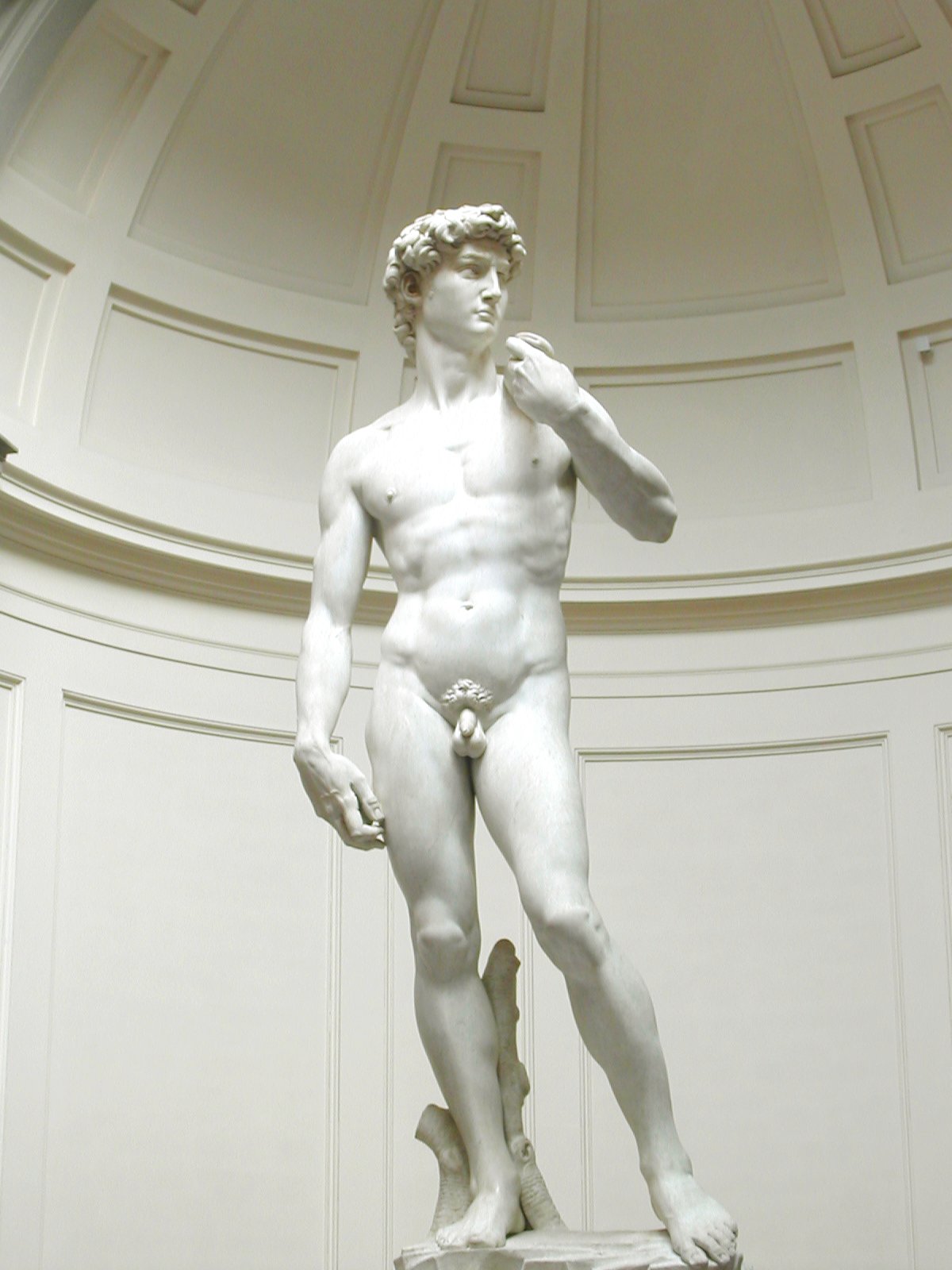
This is Michelangelo's David, perhaps the most famous statue in the world.  It is easy to see David as a representation of King David from the Bible, and perhaps in some way he is.  However, that figure is not King David's in one notable way: the figure is uncircumcised.

So what is David?  I'll leave the details of the case to the art historians, but some now believe that David was a statement of utter human perfection and of the perfection of humanity.  He towers over the onlooker, and such extraordinary detail and attention has been paid to his every line and feature. Michelangelo was one of the great humanists of the Renaissance, and this was one of his crowning works.

Look for humanism, and see if you can't find it in every seam, every pore, every mindless and intentional action of our society.  We arose from the Renaissance, and it shows. It pervades the fabric of our society, integral and invisible at the same time.  It is so universal in the modern world that it can be difficult to describe what it is.   If you're interested, get yourself a copy of Francis Schaeffer's How Should We Then Live, which chronicles the rise of Western thought and how it influenced the modern world.  (I can't vouch for absolutely everything Schaeffer says, but the historical aspects of the book are excellent.)

I've heard the case made elsewhere that the average Christian thinks like a humanist, not because he wants to, but simply because of the world he lives in.

Let's go a little deeper.  I tend to think of the Biblical Fall as a metaphorical, symbolic description of an actual event that happened in some way, in some sense when human beings first became conscious. 

So is humanism perhaps the oldest lie of all?  How it ingrains itself into us!  How we carry it from birth!  Is this the echo of Adam's sin? Was that our sin: taking into ourselves the knowledge of good and evil, trying to make it part of us, to be found within us?  
This is how I see humanism when its trappings are stripped away: "... you will be like God, knowing good from evil..." 

Humanism is believing that we are god.  Isn't this the root of every sin - that we believe we are god?  Is it not simply a claim to be greater, to know more, to be more perceptive than God?

Is it not the root of our suffering?  How could we possibly be content or at peace while engulfed in such a glaring inconsistency as the delusion that we are god in a universe in which the deepest truth is that God is God?  Is not the source of our deep discontent exactly that we want to be god, believe we are, and yet the universe does not obey our will?  Do we not suffer because we want and do not have, because we lack and cannot fulfill ourselves?  We continue in this delusion that we are god, and the incongruities sting.

We tire, we ache, we hunger, we age.  A god does none of that, so we are frustrated and painfully perplexed.  But who has ever heard of a god who is perplexed?  This is another fresh source of misery.

Then we rage that the true God does not end our pain, stop our dying, and explain our confusion.  In other words, we rage at God for not making us gods.

When I look deep inside myself, I see this so clearly.  I want to be god.  This is my true nature.

So is my fall not of my own doing, when my soul utterly rejected God's supremacy?  What is Hell but having one's deepest longing most absolutely thwarted?  What is Hell but a being who longs for nothing more in all the universe but to be god, but knowing full well that it most certainly is not and never shall be?

Yet I cannot free myself of it!  Some part of me longs to be god so deeply that it believes the delusion that it is.  Yet having my deepest-held beliefs blatantly shattered every day is agonizing. Who will save me from this body of death?

This is just my late-night musings, and only that.  I'm just another human being, and a young one at that.  But this is what I wonder about.

Last thought of the day -
What, then, does it mean that now we eat the Body and Blood of God, by God's own command?  When God became man, a way was provided to free man from his delusion of being god.  Is Eucharist the antidote to the clutches of humanism?

Inspired by: http://virtuouspla.net/2011/08/31/miracles-happen/

Friday, August 19, 2011

Why I Stink

The blogposts about my travels are going to be on hold for a while.  I would love to write more about them, but I simply, honestly, truly don't have time.

I started medical school on Monday, and I do not want to miss the opportunity to write about that.  Also, I no longer have anywhere near as much time as I did.

Since it's Friday, I'll do Seven Quick Takes about Medical School, in honor of Jen at Conversion Diary.


-1-
I'm in medical school!  I have this realization every few hours and think once again how very lucky I am.  My dream is happening, and it's wonderful.

-2-
Medical school is hard.  

This semester, I am taking Biochemistry, Developmental Anatomy, Gross Anatomy, and Histology. This translates roughly to: 
Biochemistry - 
Chemistry on steroids and chemistry OF steroids,

Developmental Anatomy (aka "Devo") - 
A Baby Story: the Little Blastocyst That Could, 

Gross Anatomy -  
There are twelve thoracic vertebrae.  Each has two costal facets that articulate with the ribs.  These sit superior and anterior to the pedicle and lamina, which form the intervertebral fosamina, through which run the spinal nerves.  The greater dorsal nerve runs distally to the suboccipital triangle, made of the rectus capitis posterior major muscle, the obliquus capitis superior muscle, and the obliquus capitis inferior muscle.  The transverse process of the atlas runs laterally through the triangle, just inferior to the vertebral artery and the suboccipital nerve.
Didn't know this?  Neither did I, two days ago.  

Histology (aka "Histo") - 
SO MANY CELLS.  400 CELLS.

-3-
The medical students I've met are uniformly brilliant, dedicated, and hardworking.  It's fun to be in class and know everyone there cares just as much as you do and is studying every bit as hard.

-4-
Much of what I learned in college about how to learn is wrong.  Well, it's right if you're studying math.  But it's not right if you're studying medicine.
Studying math is like trying to uproot a tree.  You have to know the layout and understand the theory of trees and think really hard and have the right tools, and then in a burst of effort, the tree comes out.
Studying medicine is more like finding that 10,000 weeds have popped up in your yard.  You work really hard and pull up all the ones you can find, trying to get the roots out but not spend too much time on any one.  The next morning, there are 10,000 weeds in your yard...

So I'm not doing as well as I thought I would.  My brain is honed to learn mathematics.  I'm counting on the flexibility of the human brain to let me rewire things posthaste. 

-5-
Being allowed to dissect a human cadaver is a supreme privilege like no other.  It's a tremendous honor to be allowed this form of intimacy with this person's body that even she never had.  

It's also a fantastic way to learn.

-6-
Being allowed to dissect a human cadaver makes you reek.  I've dedicated a set of scrubs and the lab coat they gave us to just gross anatomy lab.  When I'm not wearing them, they live in a sealed trash bag in my locker at the school.  
I don't think I can do much to get that smell out of my hair, though.

-7-
Medical school is taking my life from me completely.  I've abandoned hobbies, down time, and socializing to keep up with it.  
But I can give up those things.  I just can't give up medicine.  It's an easy trade.

Have a good weekend, everyone!

Friday, August 5, 2011

A Little Penguin's Hard Choice

Hello!

As promised, here I will tell you what happens when we run out of medicine.

But first, giraffes!

The third day we were in Galana Ranch, our host arranged a treat for us after work.

So after we finished clinic for the day, our group piled into our Land Cruiser and Land Rover and set off across the African savannah.


One of our noble steeds

Looking over the top of the truck

We drove off the road for at least fifteen minutes with the general feeling that this was going to be a long, disappointing trek of nothingness while we were hungry and tired.  We saw a few DLA's and maybe a rabbit, but that was it.

Suddenly, the oldest Kenyan guide peered at the horizon ahead and shouted something to the driver.  The driver turned the truck away from the mountain and began cautiously steering the truck through the brush.  Occasionally we would stop and the Africans would peer intensely at various places on the horizon, then we would set off again.

I couldn't see anything.  There were a few tan-colored boulders up ahead, but nothing terribly exciting. 

Then one of them moved.


What I thought were boulders were elephants.  Massive, gentle, and beautiful, they stood in a group and eyed us warily.  A group of zebras stayed with them.


We even saw ostriches!


Here we were, deep in the African savannah, on safari.  There was one more animal in particular I wanted to see.  The elephants and zebras and ostriches had been so amazing, more than I'd ever hoped to see in my life. 

But I wanted so much to see a giraffe.  By this time, it was getting dark, but our guides decided to show us one more place where we just might see some wildlife.

We drove to a sheltered area near the mountain, and there they were.

Our pictures barely turned out, but we saw giraffes.  They were gorgeous, graceful, and timid.  They generally did not let us get very close to them, sauntering on as a herd whenever we approached.  But they were spectacular, and I'll never forget how they looked in the waning evening.


Later in the trip, we got up early before clinic and detoured to a spot on the river where hippos were known to congregate.  We kept our distance; hippopotamuses kill more people in Africa every year than any other animal.  One of our group recalled seeing a video (which I can't find right now; sorry) of a hippopotamus absolutely demolishing a Jeep.

These pictures use a lot of zoom; we were not this close.


This was an amazing way to start our last day of clinic.


Our last day of clinic ended on a much heavier note, however.

The last day of work at any given place on a medical trip like this involves some heart-wrenching rationing.  We cannot see everyone.  We moved into aggressive triage, where the nurses would send only the most complex cases to the doctors.  Most people were simply given vitamins and pain medication and a kind smile.
When we no longer have time to do even that, we each grab several packages of vitamins, parasite medication, and Tylenol and start giving them to people. Nothing could have prepared me for the reality of holding this medication and having to choose who it went to.  The ten-year-old or the sixty-year-old?  The sick baby or the nursing mother?  The working father or the growing child?

This is what happens when we run out of medicine, and it's heartbreaking.

On the way back to Malindi from Galana Ranch, one of the sweet young ladies on our trip got to talking with our guide, who told her that the whole Galana region was going into drought and devastating famine. 
Shocked, she looked up. "So what will happen to those people we saw?"

"Many will lose everything they have, and many will die." 

I'm a bit glad I only learned this after we left, not while we were still meeting people and playing with the beautiful children.  But this still haunts me after nearly two months.  I try to remember that we improved these people's health and gave them the best possible chance to withstand the famine.  At the end of the day, however, I simply have to offer up a prayer for them and try to get some sleep.

Next time: the last of Kenya and walking into a whole new world.

Tuesday, July 12, 2011

The Little Penguin and the Poor Goats

Hello!

I have a bit of free time, so I'll proceed to write about our first week in Kenya.  We spent the first few days traveling.  British Airways treated us with the typical British courtesy.  It was the best treatment I've ever received on an airplane.  They brought us tea.

Tea!

Kristi, Pingu, and me on the airplane
This thing was on the back of the seat in
front of each passenger.  We could watch as
our plane passed Greenland, or crossed into
England.  Awesome.


Finally, we arrived in Kenya.  I definitely had to remind myself that this was not Houston, Texas.  We were in KENYA.
KENYA.

I kept thinking things along the lines of, "Whoa, we are in Kenya, guys. Like really really.  This is Kenya. See that tarmac? That is Kenyan tarmac..."

Our team was split into two groups.  My group (of about fifteen: two doctors, two nurses, four medical students, and various administrative people and translators) left Malindi and traveled to Galana Ranch.  Malindi is along the eastern coast, so it's lush and green.  But Galana Ranch is further west into the savannah, and that area was rather dry.  
We traveled in a mutatu, which is a safari van.  We were told it would be a two-hour drive, roughly.  I failed to anticipate that "two-hour drive" does not mean two hours of interstate highway.  It means two hours of this:

(Not our photo)


It was fun, nevertheless.  I kept looking around, as we left the city and passed into native villages with mud huts, and thinking that this was very nearly the "human wild-type".  Human beings are thought to have evolved in Africa.  It was really interesting to "get back to our roots", so to speak.  

Eventually, we arrived at our tent camp.  Galana Ranch is a government-owned game preserve, containing something like 1.6 million acres of land.  The administrative area has a dispensary for the park employees, which is where we would be working.  Several tribes live in the preserve, and we saw mostly people from those tribes.  
Every day, we drove about 40 minutes from our tent camp to the administrative center.  We rode in the back end of a Land Cruiser, which was bumpy but afforded us a great opportunity to talk and get to know each other.  

Wazungu in the back of the Land Cruiser


We also got to see plenty of wildlife.  We saw so many impalas, dik-diks, and similar creatures that we took to calling them DLA's: deer-like animals.

Two DLA's (deer-like animals)
We also got to see warthogs, monkeys, and lots of birds.


We ate all our meals in the house of a local official named Jerma.  He treated us like kings in every way, even bringing in a nationally-renowned chef to cook for us.   

The second day, the tribe we were treating was so grateful that they gave us two goats in thanks.


We ate goat stew with rice, chapatis, and cabbage for lunch and supper every day we were there.  With meals and in the afternoons, they brought us chai tea made with goat milk.  We were all very, very tired of goat stew (and of African food in general) after the third or fourth time, but still felt like honored guests.  The natives might only have meat once or twice per month.  In their kindness, these people provided our group with roasted, stewed goat twice a day for a week. 

Jerma's house was along the Galana River, and the views were breathtaking in every direction.


The first day we arrived, while waiting for lunch to finish cooking, they called us over to the river's edge.  The park guards went right down to the bank and began whistling and beating on the bank with a fresh goat skin.


A few feet offshore, something began moving in the river.  They pointed it out to us, and told us this was the mamma, the second-largest of the family.


She approached frighteningly fast, climbing up the bank.  They threw bits of goat skin to her, which she eyed carefully and snatched in a lightening-fast motion.

They even gave her whole legs, which she crushed with her jaws and swallowed.


They called her Mrs. Gibson, and she was an African crocodile.  Her legs, as you can see, are so powerful; she could propel herself up the bank in no time at all.  

Her mate and baby remained in the river for the most part, but this amazing "calling of the crocodile" was repeated almost every day.  We eventually saw all three crocodiles come up the bank at different times.

We waited safely on a rock outcropping during this display.  None of us got very close to the river.

The medical work was the most memorable part of the trip, however.  We had to work through translators, sometimes one who translated English to Swahili, then another who translated Swahili to the tribal languages.  Most of the complaints were very similar: muscle and joint aches from carrying heavy loads (and heavy babies) over long distances, parasites, infected wounds or bug bites, and sinus problems due to the smoke from indoor cooking fires.  We gave them what we had and arranged surgeries in Malindi where we could.
I spent most of my time taking vitals.  But I also got to float, working wherever people were piling up. This enabled me to see the pharmacy work, the blood tests, and the doctors' work.
Dad eventually took to calling me the "Rocephin Queen" because I gave so many injections of Rocephin, a powerful antibiotic.

Thanks to some dedicated mentors, I learned more medicine this trip than I ever have on a mission trip.   I got to listen to a fetal heartbeat and feel the baby's head.

Dad showed me a case of elephantiasis.  Elephantiasis is an incredibly rare parasitic disease in the United States, so much so that most physicians will never see a case of it in real life. Luckily, it's easily treated.
Elephantiasis in right leg

Probably a parasitic infection.  This
parasite may or may not have ever been
described by modern medicine.

These are people from the tribe waiting after being seen
to walk back to their village.
We treated a lion bite.  The man inadvertently herded his goats into the lion's territory.  His back had some deep scars where the lion attacked him.  The locals said that if the lion had wanted to hurt him, he'd be dead.  Apparently, the lion only wanted to give a warning.

Next time: giraffes, and what it means when we run out of medicine.

Thanks for reading!